SYSTEM DESCRIPTION
The system permits to improve the quality of the service to the customer using a multiple and diversified series of functions that allow the monitoring and the optimization of the management, elevating the levels of comfort and emergency, saving energy, and consequently reducing the costs. All the system components, integrated in a solution based on the concept of distributed intelligence, offer the possibility to keep under control, from a single PC, various problematics of an hotel allowing to modify parameters, giving information on whichever malfunctioning, and to take decisions in order to improve the customer satisfaction.
The system is composed of a PC that represents the main processing unit. Into the PC is installed the room supervision program; the PC can be connected to the network and to other computers through protocol TCP/IP, managing the front office and the administration of the hotel.
All the connected PCs, if predisposed with relative coder, can create the access keys to the rooms and give informations about the state.
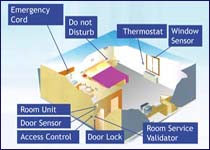
The system is subdivided in two main areas which enjoy a such autonomy to increase the safeness of the same system. The system has peripheral units placed in any room and one data-concentration unit that links room units and provide datas to the customer in a graphical way.
The system provides the following functions:
- Room access control through transponder, for the hotel customer and the service staff.
- Room microclimate control with automatic function of ENERGY-SAVING if room is not occupied.
- Management of all room alarms such: emergency call, intrusion, flooding risk, occupied room, indication of ready room, exclusion of electrical services if the room is empty, management of electrical services if the room is occupied.
The front office operator gets info on the video of the PC about the status of every single room through a graphical scheme and is informed about general conditions and events into the whole hotel.
From the reception it’s possible to control in which room has been made an emergency call, it’s possible to evidence the rooms in phase of rearrangement and those ready for being given to a new customer or those out of duty for maintenance. It’s also possible to control and to vary the temperature in every room and the value of set-point, allowing the hotel manager to set those parameters that can vary in every country adapting to its law.
The alarms generate an acoustic signal, in order to attract the attention of the operator, and are chronologically recorded in the archive, with the possibility of printing them.
While making a check-in it’s possible to codify one or more electronic keys to assign them to the customer; the code is generated in order to guarantee that there’s no possibility to have two cards with the same code for more than one room.
It’s possible to use the electronic key not only for the room access but also in order to pay services enjoyed inside of the hotel with an automatic direct debit transaction on the customer personal account (optional); when the account is closed (check-out) these services are disabled, as is disabled the access to the room and to the common areas.
In the event that the room is occupied by more than one customer is possible to have more copies of the keys that open the same room but with different identification codes.
The status of the room unit in all its complexity is guaranteed even in case of a broken connection to the central unit allowing the customer to normally use the room.
The system identifies the access of the hotel staff subdividing in categories using hour bands of possible access and giving the possibility to subdivide the hotel in areas of different competences; it’s also possible to install other readers in the common areas in order to allow the customer, if qualified, to approach particular zones (box, conference hall, gym, etc.).
All the accesses however are sent to the processing unit and stored inside in the archives for eventual future controls.
|